
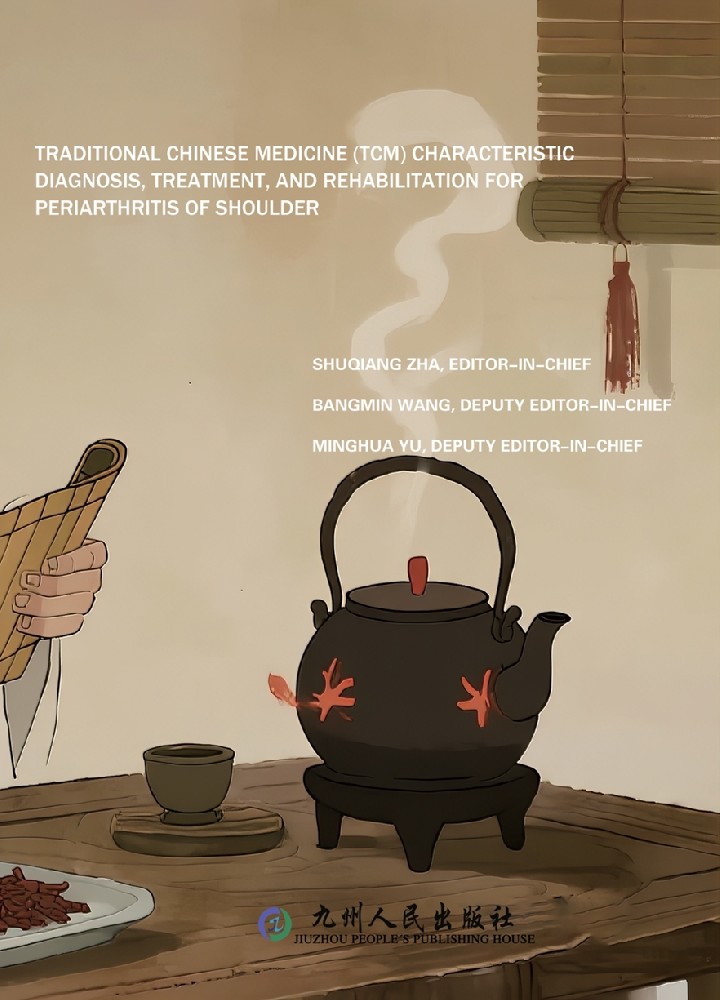
题目:Decoding the Future:Reconstructing English Literacy in the Digital Humanities Context
主编:Shuqiang Zha
副主编:Bangmin Wang;Minghua Yu
出版社:九州人民出版社(Jiuzhou People's Publishing House)
日期:2025.08
学科分类:中医
语言:英文
ISBN:9781965806074
DOI:10.64649/yh.jzrmcbs.9781965806074
摘要:
In modern society, with the change of lifestyle and the aggravation of population aging, the incidence rate of shoulder diseases is increasing year by year. As a common chronic disease, periarthritis of shoulder (periarthritis of shoulder for short) has a serious impact on the quality of life of patients.Shoulder periarthritis is mainly characterized by shoulder pain and limited mobility, and the condition is lingering and difficult to cure. It not only leads to a decrease in the patient's daily living ability, but also may cause psychological problems such as anxiety and depression, bringing a heavy burden to individuals, families, and society.
关键词:
Modern society;Population aging;Shoulder diseases;Periarthritis of shoulder
Chapter 1: Traditional Chinese Medicine Understanding of Shoulder Periarthritis 1
Section 1: Historical Origins of Traditional Chinese Medicine for Shoulder Periarthritis 1
Section 2: Interpretation of Traditional Chinese Medicine Causes of Shoulder Periarthritis 21
Section 3: Traditional Chinese Medicine Syndrome Differentiation and Typing of Shoulder Periarthritis 34
Chapter 2: Traditional Chinese Medicine Internal Treatment Featured Therapy 48
Section 1: Principles for Selecting Prescriptions and Medications Based on Syndrome Differentiation 48
Section 2: Analysis of Classic Formulas 70
Section 3: Selection of traditional Chinese patent medicines and simple preparations 87
Section 4: Case Analysis of Traditional Chinese Medicine Internal Treatment 107
Chapter 3: Traditional Chinese Medicine External Treatment Featured Therapy 123
Section 1: Traditional Chinese Medicine Fumigation and Washing Therapy 123
Section 2: Plaster Therapy 134
Section 3: Sanfu Tie Therapy 147
Section 4: External use therapy of paste drugs 156
Section 5: Case Analysis of External Treatment with Traditional Chinese Medicine 169
Chapter 4: acupuncture and moxibustion Characteristic Therapy 184
Section 1: Principle of acupuncture and moxibustion and Moxibustion in Treating Scapulohumeral Periarthritis 184
Section 2: Common Acupoints and Acupuncture Techniques 196
Section 3: Fire needle, warm acupuncture and moxibustion, ear acupuncture, electroacupuncture and other special acupuncture methods 203
Section 4: Treatment course and precautions of acupuncture and moxibustion 219
Section 5: Case analysis of acupuncture and moxibustion treatment 225
Chapter 5: Tuina Featured Therapy 237
Section 1: Mechanism of Massage Treatment for Shoulder Periarthritis 237
Section 2: Detailed explanation of commonly used massage techniques 244
Section 3: Stage Strategies for Massage Treatment 254
Section 4: Precautions for Massage Treatment 262
Chapter 6: Small Needle Knife Featured Therapy 275
Section 1: Principles and Characteristics of Small Needle Knife Therapy 275
Section 2: Operation method of small needle knife for treating shoulder periarthritis 282
Section 3: Indications and Contraindications for Small Needle Knife Treatment 296
Section 4: Rehabilitation and Nursing after Small Needle Knife Treatment 305
Chapter 7: Characteristics of Moxibustion and Cupping Therapy 317
Section 1: Moxibustion treatment for shoulder periarthritis 317
Section 2: Cupping therapy for shoulder periarthritis 331
Section 3: Combination therapy of moxibustion and cupping 344
Chapter 8: Comprehensive Traditional Chinese Medicine Treatment Plan 357
Section 1: Advantages and Principles of Comprehensive Treatment 357
Section 2: Development of Personalized Comprehensive Treatment Plan 371
Chapter 9: Traditional Chinese Medicine Rehabilitation Exercise and Prevention 391
Section 1: Traditional Chinese Medicine Rehabilitation Exercise Methods 391
Section 2: Precautions for Rehabilitation Exercise 410
Section 3: Traditional Chinese Medicine Preventive Measures for Shoulder Periarthritis 438
Chapter 10: Research progress and prospects of traditional Chinese medicine in the treatment of shoulder periarthritis 445
Section 1: Validation of Traditional Chinese Medicine Treatment by Modern Research 445
Section 2: Innovative exploration of traditional Chinese medicine treatment for shoulder periarthritis 448
Section 3: Outlook on Future Development Trends 451
Conclusion:456
References:459
Preface
In modern society, with the change of lifestyle and the aggravation of population aging, the incidence rate of shoulder diseases is increasing year by year. As a common chronic disease, periarthritis of shoulder (periarthritis of shoulder for short) has a serious impact on the quality of life of patients.Shoulder periarthritis is mainly characterized by shoulder pain and limited mobility, and the condition is lingering and difficult to cure. It not only leads to a decrease in the patient's daily living ability, but also may cause psychological problems such as anxiety and depression, bringing a heavy burden to individuals, families, and society.
The shoulder joint is one of the largest and most flexible joints in the human body, with a complex structure composed of bones such as the scapula, humerus, clavicle, as well as numerous soft tissues such as muscles, tendons, ligaments, and bursae.It is precisely this high degree of flexibility that makes the shoulder joint relatively fragile and susceptible to damage and degeneration.There are various causes of shoulder periarthritis, including external factors such as cold shoulder, trauma, and excessive fatigue, as well as internal factors such as tissue degeneration, physical weakness, endocrine disorders, and decreased immune function caused by aging.In traditional Chinese medicine theory, shoulder periarthritis belongs to the category of "Bi syndrome", and its onset is closely related to the invasion of external pathogens such as wind, cold, dampness, and heat, as well as internal factors such as insufficient qi and blood, liver and kidney deficiency, phlegm and blood stasis obstructing collaterals.
Faced with the common disease of shoulder periarthritis, Western medicine treatment often uses methods such as nonsteroidal anti-inflammatory drugs, glucocorticoid injections, physical therapy, and surgical release.These methods have certain effects in relieving pain and improving joint function, but there are also some limitations.For example, long-term use of nonsteroidal anti-inflammatory drugs may cause gastrointestinal adverse reactions;Although glucocorticoid injections can quickly alleviate symptoms, repeated use may lead to complications such as tendon degeneration and osteoporosis;Surgical treatment is more traumatic, has a longer recovery period, and is not suitable for all patients.In contrast, traditional Chinese medicine has a long history and rich experience in treating shoulder periarthritis, forming a unique theoretical system and treatment methods.Traditional Chinese Medicine emphasizes the holistic concept and dialectical treatment, believing that the occurrence of shoulder periarthritis is the result of the combined effects of internal and external factors in the body. Treatment should not only alleviate local symptoms, but also regulate the whole body's qi and blood, eliminate the cause, and achieve the goal of treating both symptoms and root causes.After thousands of years of practice and development, the methods of traditional Chinese medicine to treat periarthritis of shoulder have become increasingly rich, including oral and external use of traditional Chinese medicine, acupuncture and moxibustion, massage, small needle knife, moxibustion, cupping, etc. These methods are simple, effective, and have little side effects, which are widely recognized and welcomed by patients.
However, despite the many advantages of traditional Chinese medicine in treating shoulder periarthritis, the current books on the treatment of shoulder periarthritis in the market are either too academic, with complex and difficult to understand content, and are not suitable for ordinary readers and grassroots medical staff to read;Either the content is brief, lacking systematicity and practicality, making it difficult to meet the needs of clinical treatment and scientific research.Based on this, the book "Characteristic Therapy of Traditional Chinese Medicine for Treating Shoulder Periarthritis" has been compiled, aiming to systematically sort out the theoretical knowledge and practical experience of traditional Chinese medicine in treating shoulder periarthritis, and provide a practical and authoritative reference book for medical workers, researchers, and patients with shoulder periarthritis.
This book is divided into ten chapters, covering the understanding of Chinese medicine on periarthritis of shoulder, Chinese medicine treatment, acupuncture and moxibustion treatment, massage treatment, small needle knife treatment, moxibustion and cupping treatment, Chinese medicine comprehensive treatment scheme, Chinese medicine rehabilitation exercise and prevention, research progress and prospects of Chinese medicine on periarthritis of shoulder.In the process of writing, we always adhere to the following principles: firstly, scientificity. The theoretical knowledge and treatment methods involved in this book are based on traditional Chinese medicine theory and clinical practice, and refer to a large amount of domestic and foreign literature to ensure the scientific and accurate content;Secondly, practicality is emphasized in this book, which emphasizes the connection between theory and practice. It provides a detailed introduction to the operational steps and precautions of various treatment methods, and analyzes them with typical cases, making it easy for readers to directly apply them in clinical practice;Thirdly, it is systematic. This book forms a complete knowledge system from the understanding of traditional Chinese medicine on shoulder periarthritis to specific treatment methods, rehabilitation prevention, and research progress, enabling readers to comprehensively and systematically understand the relevant knowledge of traditional Chinese medicine in treating shoulder periarthritis;The fourth aspect is innovation. Based on the inheritance of traditional Chinese medicine theory and methods, this book absorbs the research achievements and latest developments of modern medicine, introduces some new treatment concepts, methods, and technologies, and reflects the characteristics of traditional Chinese medicine in treating shoulder periarthritis.
It should be noted that although this book provides a detailed introduction to various methods of traditional Chinese medicine for treating shoulder periarthritis, the condition of shoulder periarthritis is complex and varied, and there are individual differences in the patient's constitution and condition. Therefore, in clinical application, readers should treat according to the patient's specific situation, choose treatment methods flexibly, and consult professional traditional Chinese medicine physicians if necessary.At the same time, for some patients with severe conditions and ineffective conservative treatment, timely surgical treatment and other methods should be adopted to avoid delaying the condition.Due to the limited level of the editor, there are inevitably omissions and shortcomings in the book. We sincerely request readers and peers to criticize and correct us, so that we can improve it in future reprints.
投稿邮箱:
xgyhcbs@163.com
jzrmcbs@163.com